Wednesday, September 10, 2008

Love... Seahorse Style


The blog aquatic went on a brief hiatus. Temporarily swallowed, chewed and spit out by a white shark. But the blog is back. A little salty, sure. But limbs in tact.

Just a brief post on one of the wonders of the aquatic world, the seahorse. More specifically: seahorse birds and bees.

So the rampant seahorse rumors are true: it is the male seahorse who gets pregnant and gives birth. The woman deposits her eggs in the male's so-called brood pouch. Then the male fertilizes the eggs, where they mature inside him for around 3 weeks.

When it comes time to give birth, the male goes into a sort of seahorse labor, where he has muscular contractions and expels the babies (anywhere from a dozen to hundreds). His body shrinks (seahorse stretch marks?) and he loses color. Typically this happens at night and yet- miraculously- he's usually ready for a new batch of eggs by morning.

...But before the babies, there is, of course, the courtship.

Seahorses are monogamous and their flirtation is elaborate. When two seahorses realize there is a mutual interest, they start a ritual 'pre-dawn' dance where they swim together, holding their tales or swirling around a single blade of grass. This can last for days. They dance, change color in a sort of seahorse-blush and tell eachother all the little hippocampus secrets of their heart.

Finally, they're ready... The two seahorses drift out of the sea grass, snout to snout, often twirling and spinning. The female deposits her eggs into the male- and to the brood pouch they go.

Throughout the male's pregnancy, the female continues to see the male for short daily morning visits, where they reenact their courtship days. “They change color, wheel around sea grass fronds, and finally promenade, holding each other’s tails. Then, the female swims away until the next morning, and the male goes back to vacuuming up food through his snout.” (from the article, "Pregnant- and Still Macho- Seahorses")

While the pregnancy and courtship rituals of seahorses are not exactly an evolutionary fluke, the male still expends less energy overall despite his pregnancy, and can exhibit aggressive competitive behavior...there's still something, well, sweet about the whole thing, from their twirling dances, to the male's brooding pouch.

In the food chain battles, trenched mysteries and general weirdness of the aquatic world, the seahorses are small reminders that, even in all this, there's room for a little lovin' - snout to snout, in the sea grass.

Thursday, July 10, 2008

Thursday, May 8, 2008

Blog Aquatic Goes to the Shark Cafe

For the better part of this year, Very Special Friend to Blog Aquatic has been working on a documentary. An aquatic documentary, that is. Seeing as this blog appreciates the quirkier, cuter side of the aquatic, we commend Special Friend for making a film on the cuter and quirkier side of an unlikely source: The Great White Shark.

Considering how many fears and nightmares surround the Great White Shark (to this day the Blog Aquatic gets a little ansy in the deep end of a pool), there is very little that is actually known about the sharks. Shockingly little in fact. For years our understanding of the Great White Shark has been reduced to the sensationalized, blood-thirsty images of Jaws reruns and nature shows.

But, as the film, Shark Cafe, explores -- all this is about to change. White shark research is now making unprecedented growth, with the most important research happening right here in the San Francisco Bay Area. Biologists and researchers are learning more about the great white than ever before. Developments in technology, along with changing public perceptions, are creating a unique moment in great white history. We have the opportunity to dramatically change our understanding -- and appreciation-- of the Great White Shark's role in the ecosystem.

Shark Cafe is smart without being too flashy, insightful without giving too many easy answers. This film has amazing archive footage, brawny marine biologists, and of course sharks as you've never seen them before. Please join me at the film's premiere next Friday before it moves on to aquatic film festivals everywhere (Here's to Ocean Film Festival 2009).

See you at the screening:

Shark Cafe:
A Curious History of The Great White Shark from Jaws to Facebook

NorthGate Hall, Room 105

Friday May 16th, 2008
6:30 pm
(Directions to NorthGate Hall on the UC Berkeley Campus can be found here.)

Monday, May 5, 2008

The Blog Aquatic Goes to Boston


This past weekend Blog Aquatic left the sunny warmth of the West Coast and headed East to visit special sister to Aquatic Blog, Octopus Cake. Because so many of my devoted blog readers hail from the greater Boston area (ok, just Dan), I thought Blog Aquatic readers would appreciate an update on one of the more quirker aquatic gems to be found in the little-city-that-could. The lobster? The harbor? No. I'm talking of course about the glass sea creatures of the Harvard Museum of Natural History.

Glass sea creatures? We were initially suspicious as well. But these meticulously-constructed glass animals embody the kind of neurotic precision and obsessive fanaticism that is the true Blog Aquatic spirit. A German father and son team, Leopold and Rudolph Blaschka, created these shockingly lifelike representations of underwater invertebrates in the late 19th century. Originally commissioned for the Harvard Museum of Comparative Zoology, the sea creatures were used as teaching tools.

The exhibit currently on display is one of a much larger collection that also includes the Blaschkas' more famous glass flower sculptures. The sea creatures include jellyfish, octopi and even mysterious animals called sea pens. (Futher Blog Aquatic research found that the strange sea pens are in the same phylum as jellyfish, or Cnidaria.) Here are just a sampling of the Blaschka's incredible handiwork:


As if their manic fascination with sea creatures was not enough for us to revere the Blaschkas, I was further heartened to learn that Leopold Blaschka also kept a pet snail. Yes. A pet snail.
Leopold named the snail Lotte, and the two co-existed peaceably for some eight years until Lotte the Snail's death. Yes- 8 years. The current exhibit on display at Harvard actually includes Lotte's shell-- as well as an epitaph that Leopold wrote for his dear snail.


Oh Leopold. Oh Lotte.


More on my edible aquatic adventures of Boston in later posts...

Monday, December 17, 2007

Lumpfish, Oh My


Dan sends us yet another gem. The aptly-named Lumpfish or Lumpsucker. While it looks like a distant cousin of Jabba the Hut, the lumpfish is no fictitious creature. It is a a small, slow-moving fish native to cold Arctic, North Atlantic and North Pacific Oceans. In Denmark and other Scandinavian countries Lumpfish roe are actually eaten as an inexpensive alternative to pricey, luxury caviar.

But Lumpfish are so much more than cheap caviar for hungry Danes. In general the Lumpfish is small, except for the Smooth Lumpfish that can grow up to 20 inches. The Lumpfish generally hangs out on the bottom of the ocean as its weight- to- length ratio is so disproportionate (i.e. small bodies, a lot of weight), they cannot swim very fast or far. In order to camouflage on the ocean floor, they are usually beige or grey in color.

Perhaps one of the most interesting facts about the Lumpfish is the male's devotion to the eggs before they hatch. While the male waits for the eggs to hatch, he fasts so that he can stay close to the eggs. The male also fans the egg mass constantly with his lumpy fin. (The female has since moved on.) When at last the eggs hatch, the male is so thin and exhausted he cannot continue on with the babies and they swim off on their own. This story of male devotion rivals that of the Empire Penguins. Move over March of the Penguins!

(Finally, I should also mention that in my research I learned the Lumpfish is not only a rather ungainly, fleshy-looking fish, but it is also the name of a party-rock/cover band in Connecticut. Lumpfish sets are "designed to get people off their asses early and keeping them dancing drinking and singing all night long." If anyone is ever in Connecticut, please oh please check out the Lumpfish.)


Monday, December 3, 2007

The Rebirth of Aquatic


Oh abandoned Blog. I've let you down with my prolonged absence. But in light of oil spills, crab seasons, and my ever-loyal readers-- I cannot stay away from you. Aquatic Blog is back (in baby blue!) with a crop of exciting new aquatic tales...

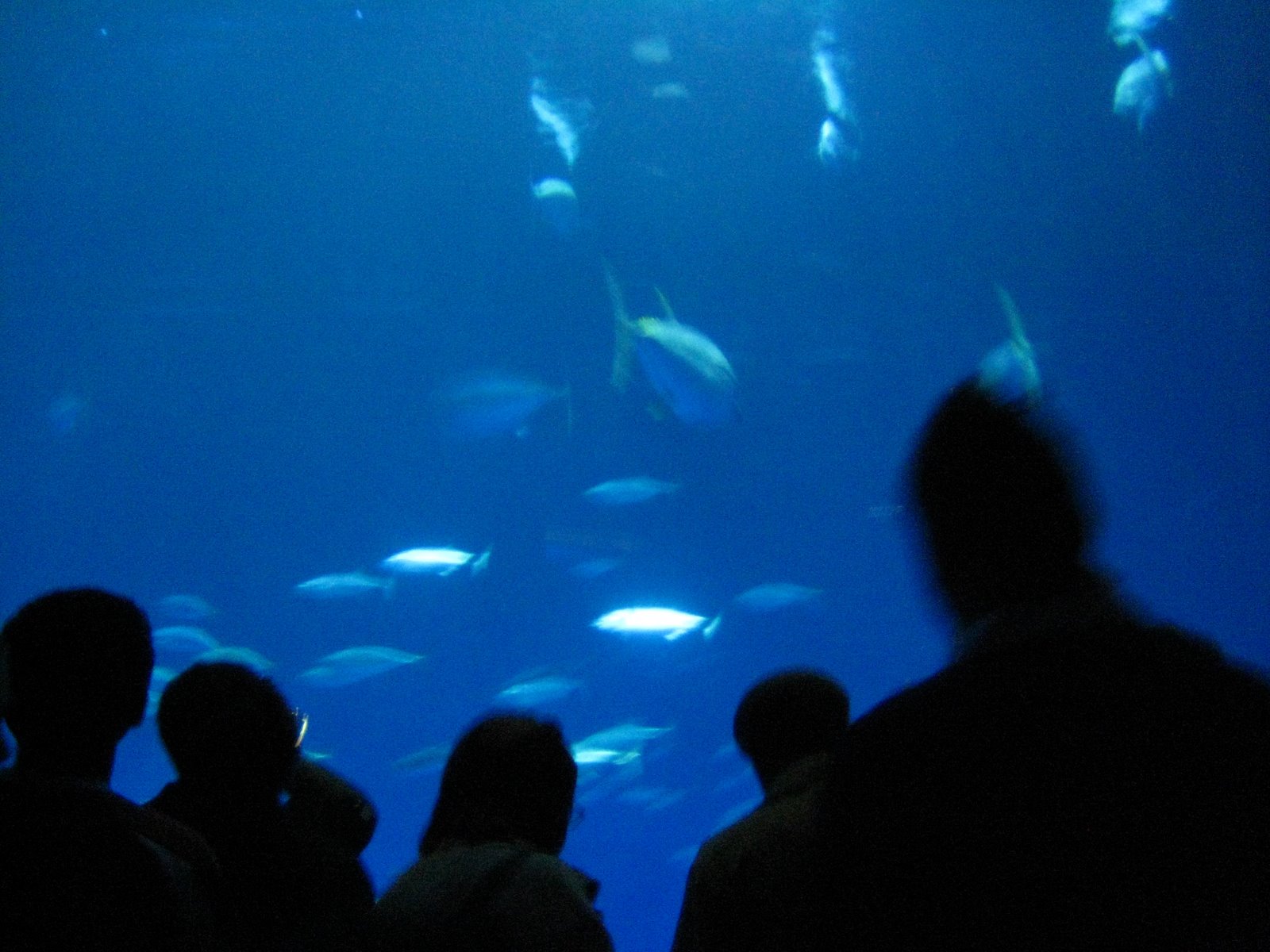
I thought it best, on this relaunching post, to visit Aquatic Blog's personal Mecca-- The Monterey Bay Aquarium. Opened in October of 1984, the MBA - along with its sister organization, the Monterey Bay Aquarium Research Institute (in Moss Landing) is one of the largest aquariums in the world. Funded largely by the Packard family, it has over 35,000 plants and animals, and 550 species. The famous Outer Bay exhibit alone contains over 1 million gallons of sea water. MBA was also featured in Startrek IV, "The Voyage Home" (where it was apparently called "The Sausalito Cetacean Institute"). You can check out the MBA website -- even send aquarium e-cards.

Special Friend to Aquatic Blog visited the Monterey Bay Aquarium and brought us back these lovely photos:


Stay tuned for more exciting aquatic blogs to come...

(Incidentally, this re-launching is in the memory of one Gilda the Goldfish -- couldn't have aqua-blogged without her:)

Monday, May 7, 2007

Back From The Bottom of the Ocean

There's no other excuse as to why I disappeared from my little blog: I was on a deep-sea mission (of course). In a little underwater hovercraft, I crawled to the depths of the ocean to bring you back rare and exciting finds. It was a little hairy at times. But then again, these deep-sea expositions always are. Here is my underwater hovercraft (and thanks Dan for another brilliant find):

(Can you see me waving?)

And here are some of my favorites from the exposition below. You can check out more creatures here.

Dumbo octopus or grimpoteuthis. Depth 300- 5000 meters. 20cm

Football fish or Himantolophus paucificolus. Depth 1000-2000 meters. Females up to 45 cm.

(not sure where these strange text boxes and graphics are coming from on this post, it must be technical problems from my deep-sea travels)